The Fall (The Rift, Book 1), by Robert J Duperre
 [This book has no back cover copy]
The Fall
The bigger problem, though, was the tone of the writing.
The narrative frequently lapses into a lecturing, disapproving tone which I found thoroughly off-putting. The implication is that ancient civilisations were good and modern ones are bad; and that ancient knowledge was insightful and inspiring while modern technology renders our civilisation crass and insensitive. This, coupled with a stereotypical, somewhat dismissive view of today’s South American culture gave the book an unsympathetic and judgemental edge which made me reluctant to read on.
If the writer could introduce more variety of tone, could learn to not present things in such a black and white way, and could manage to be more sympathetic to his characters, then this book would be significantly improved; and once he manages that a scrupulous copyedit would resolve the book’s other issues. Whether this would be enough to change this from an ordinary predictable read into an exciting and interesting one, I’m not so sure. I read eleven of this book’s three hundred and thirty nine pages.
In Search of the Menopause Ranch, by Deborah Vaughn
 FICTION
From the moment Kimberly woke up she knew she had to be dreaming. Or worse…. Where was she? Middle age felt like the edge of a cliff and she hadn’t decided whether or not to jump. She’s about to learn what lies ahead in this transition, if only she can find the courage.
Heart-warming, irreverent and funny, “IN SEARCH OF THE MENOPAUSE RANCH” shares the intimate lives of women who’ve been devoted mothers, caretakers, workaholics and loving wives. But now what? As time seems to stand still, Deborah Vaughn takes us on a journey of self-discovery through encounters with the Goddess and the lives of each woman as they discover what’s missing — what they almost forgot about themselves, their world and their gifts.
“I loved this book! Men, women, ancient history, the church, witches, inquisition, Gods and Goddesses—everything you wanted to know about how you got to where you are and what you can do about it. What will we do with our menopausal zest? How can we change our immediate worlds for the better—one woman, one town at a time?
Read this book— well researched, fascinating in its portrayal of history we never learned in school. All women will recognize themselves or others they know in the characters found at the Menopause Ranch. Laugh, weep, and then apply its lessons in your life. A great experience!”
Nikki Marie Welch, M.D.
Women in your middle years, what would you give to be whisked away from the cares of your daily life (by such colorful Spirit Guides as Belladonna Morose and Mea Culpeppa); to be taken to a magical realm where you’d discover the secrets of the ages that women have known since the world was new? Fortunately, to gain all the warmth, humor and wisdom of this special women’s retreat, you only have to read Deborah’s captivating novel, IN SEARCH OF THE MENOPAUSE RANCH.
Kris Neri, award-winning author of NEVER SAY DIE and the Tracy Eaton mysteries.
Deborah Vaughn attributes her straight-talking honesty to her Indiana roots. Life has been an instructive detour as an aspiring actress on Broadway, a minion in the corporate jungle and loving wife for 23 years. It was on a road trip with her sister where ‘IN SEARCH OF THE MENOPAUSE RANCH’ was born with the message that every journey in life is unique and special, just like every woman. Parts of it maybe unplanned and a bit bumpy, but by mid-life we have the skills, the talent and the guts to pave our own way.
Pisquale Productions
###
As is often the case with the books I review here, the back cover copy of In Search of the Menopause Ranch
It’s an easy enough read, and is not at all demanding: it has the usual mix of punctuation and grammar problems; it’s often confusing; and it makes all sorts of claims about research, medicine and menopause which I suspect are based more on opinion than on fact. I read twenty-five of this book’s two hundred and seventy-two pages, but that relatively high page count owes more to my lenient mood when I was reading than to the appeal of this book.
The Tourist Trail, by John Yunker
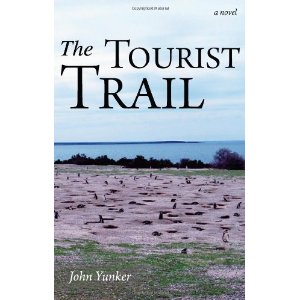 Some people stop at the water’s edge.
Some keep going…
Biologist Angela Haynes is accustomed to dark, lonely nights as one of the few humans at a penguin research station in Patagonia. She has grown used to the cries of penguins before dawn, to meager supplies and housing, to spending her days in one of the most remote regions on earth. What she isn’t used to is strange men washing ashore, which happens one day on her watch.
The man won’t tell her his name or where he came from, but Angela, who has a soft spot for strays, tends to him, if for no other reason than to protect her birds and her work. When she later learns why he goes by an alias, why he is a refugee from the law, and why he is a man without a port, she begins to fall in love—and embarks on a journey that takes her deep into Antarctic waters, and even deeper into the emotional territory she thought she’d left behind.
Against the backdrop of the Southern Ocean, The Tourist Trail weaves together the stories of Angela as well as FBI agent Robert Porter, dispatched on a mission that unearths a past he would rather keep buried; and Ethan Downes, a computer tech whose love for a passionate activist draws him into a dangerous mission.
###
It’s not often that I find myself reading the books I review here for enjoyment but by page twenty that’s what had happened with The Tourist Trail
I found all the usual suspects: too many commas, some of them misplaced; a tendency to overwriting; and a lack of clarity which meant that I had to re-read portions of the text to make sure I had understood it correctly. In a few places time seemed too elastic, and in others events seemed to collapse in on themselves, making it difficult to fully understand how time was passing, or if events were meant to be running concurrently. But the biggest problems I had concerned lack of believable characterisation and motivation: and as I didn’t believe in the people who populated the book, I couldn’t surrender myself to the story.
My main problem was with Angela, who seemed to lack a significant amount of backbone and ethics: despite being described as passionate about the penguins she was studying she barely thought twice about encouraging a handsome stranger to hang about in the penguin habitat — which was strictly off-limits to the public in order to protect the birds — and when the handsome stranger grabbed her and kissed her without warning, and without any apparent attraction or flirtation between them, she barely reacted.
I’m not a fan of writers who characterise women as passive, confused beings; nor do I like reading about men who persist after a woman tells them to stop. Especially when the women who these men persist with suddenly realise (usually halfway through a kiss) that they have wanted to the man to do this all along. It’s lazy, clichéd, and bigoted and no matter how well-intentioned the writer is, or how naive they are about why this is also wrong, or how much they might insist that I’ve missed the point, I think it’s damaging to write such scenes. I read seventy-one of this book’s two hundred and ninety-one pages and despite its promising start I cannot recommend it.
A Salute to SPANISH POETRY, by John Howard Reid
 A Salute to SPANISH POETRY
100 Masterpieces from Spain & Latin America
rendered into English verse by John Howard Reid
[This book has no back cover copy]
###
A Salute to Spanish Poetry: 100 Masterpieces from Spain & Latin America Rendered Into English Verse
Mr. Reid might well be a good speaker of Spanish; he might even be a good, if literal, translator. But he’s either no good at translating poetry; or he has picked some really bad stuff to translate.
The versions of the poems in this anthology are stodgy and dull; they’re full of clichés; they’re free from assonance, alliteration and rhythm; their meanings are often unclear, and despite each one being written by a different author there is little variation of voice or tone across the collection. This translator has neither a light nor a sensitive hand.
You have probably worked out by now that I am not terribly impressed by this book. These poems, read in this English form, lack all sense of grace and significance. But my main concern, when reading this collection, was one of copyright. While the bulk of the poems it contains are out of copyright a few of them were written more recently, which means that when this volume was published they were still protected by copyright and the permission of the authors, or their literary estates, would have been required to use them in this way. And yet there are no acknowledgements in this book; there is no attribution of where the poems were first published. But there is statement which reads “text and photographs copyright 2010 by John Howard Reid”.
Mr. Reid does not have the right to claim that copyright as the work is not primarily his: what he’s done, in putting his own copyright onto this edition in this way, is to imply that he not only translated these poems from the Spanish but that he also wrote those first Spanish texts.
As I see it, Mr. Reid has very few options open to him. He must seek written permission from the literary estates which he has exploited in publishing this book, and if such permissions are not forthcoming he must remove the appropriate pieces from his next edition; and while he’s waiting for such permissions to be granted he must withdraw this edition from sale.
If he does have the permissions required to use these works in this way then he must indicate that in all further copies of this book, and ensure that he acknowledges the authors of these poems appropriately in all future editions of this work, and in all other translations he has published.
Of course, I could be wrong: Mr. Reid might well have reached an agreement with the authors and literary estates concerned that it was fine for him to claim copyright and to use these works without proper attribution: if that’s the case then I apologise unreservedly to him for the comments I’ve made regarding copyright in this review. But I do not apologise for my comments regarding the flat and uninspiring nature of his translations. I read five of this book’s one hundred and forty eight pages, skimmed through a few more, and felt extremely reluctant to read any more of it.
Remix, by Lexi Revellian
 Fun, grit and coiled menace…
Andrew Wrigley
REMIX
Caz Tallis is living her dream, restoring rocking horses in her London workshop.
When shabby but charismatic Joe and his dog turn up on her roof terrace, she is reluctantly drawn into investigating a rock star’s murder from three years before — an unsolved case the police have closed.
Somebody is prepared to kill to prevent it being reopened. Caz needs to find out who, but is her judgement clouding as she falls in love?
Lexi Revellian really can tell a story, with an enviable economy of effort, and this book deserves to go all the way. Excellent stuff.
Elspeth Cooper, author of The Wild Hunt
Great characters, great story, pacy lucid style.
Ali McKay
###
Lexi Revellian has a lovely light touch, she’s quick to get to the action, the premise on which she bases Remix
So, what were the problems I found? The usual suspects, I’m afraid. There were a few instances of inconsistent punctuation, a random capitalisation or two, a few contradictions and some sentences which didn’t quite make sense in the context in which they appeared, which made me wonder if they were lone survivors from an earlier draft. All these things distracted my attention from the text, which is a bad thing: but these things could easily be fixed and they didn’t worry me too much: if they were the only problems with the text they wouldn’t be enough to put off an interested agent or publisher, and they didn’t stop me reading. But two issues kept on popping up, and I found them really troublesome: and they’re much more serious than the other things I’ve listed, as they are likely to be deal breakers for some readers.
Ms Revellian has a fondness for hammering her point home with big chunks of exposition. I understand that sometimes the reader needs to be told things; and that a properly-placed piece of exposition can up the stakes and keep the pace trotting nicely along: but that’s not how Ms Revellian uses exposition, and so the overall effect was to slow the pace to an unacceptable degree.
What I found more troubling was her characters’ lack of proper emotional depth. It meant that I simply couldn’t understand why they often acted as they did, and consequently I didn’t believe that the story would have unfolded the way it did.
For example, the book’s heroine, Caz Tallis, wakes up one morning to find a stranger sleeping on her roof terrace and barely questions it; before we know it she is inviting him in for coffee. Does this character have serious problems in social situations? Is she unaware of how to react to events outside the norm? I couldn’t believe this point and judging by some of the less-favourable reviews Ms Revellian’s work has received on Amazon, I’m not alone. I’m not convinced that anyone could make a living restoring rocking horses (although I understand that this is a hobby of Ms Revellian’s, which is perhaps why she chose to write about it); and [ tiny spoiler alert! ] as Joe turns out to be living under an assumed name, because under his real identity he has been declared dead, I don’t see how he could have completed all of the paperwork required to bring a stray dog back from France, nor why he would have tried to do so bearing in mind the risk of discovery inherent in such an act.
Overall then, a flawed book from a writer with potential. I read 32 pages out of 266 and hope that Ms Revellian resolves these two main issues in her future works, so that I can enjoy them more.
Among Us Women, by Joan Lerner
 There’s no filter on Joan Lerner’s angry, grieving, hopeful heroine. Her emotions bubble just beneath the surface and regularly boil over. Among Us Woman is a sometimes wondrous, often painful labor of love.” – Steward O’Nan, author of the acclaimed novel, Songs for the Missing
“Plotting reminiscent of Susan Isaacs… with the extras of lush interiors, savvy design tips and elegant meal presentations. Lerner confronts controversial topics in her debut novel but she lightens the mood with eye candy.” – Linda Ellis, author of Death at a Dumpster
“Interior Designers will be especially taken with Joan Lerner’s novel, grounded as it is in her expertise. Joan, a past president of NJASID, who then served on the national board of directors, has written a gripping story of three women with differing design careers which provide important contexts for the fast moving plot. –Ria E. Gulian, ASID, CID, Past President NJASID
Joan Lerner tackles some tough women’s issues in her new novel Among Us Women. The three women who share the novel’s pages are very different but hold common ground with which most of us can identify and relate. The author’s insight is compelling and her conclusions thought-provoking. I liked it; you will too.” – Jean Kelchner, author of Backstage at the White House.
An exerpt from Among Us Women, was published in NEWN, New England Writers Network. “An excellent example of set piece scenes. There is plenty of conflict, emotion and motivation.” – Liz Aleshire, (1949-2008), author of 101 Ways You Can Help: How to Offer Comfort and Support to Those Who Are Grieving (Sourcebooks 2009)
This provocative novel is built on the overlapping stories of three women whose professional, marital, political, religious and sexual lives echo social controversies; feminism, abortion, AIDS, of the decade following the mid-eighties. One becomes pregnant through IVF and opts for single motherhood when her homosexual husband deserts her. Another is born again and believes her salvation lies in saving unborn babies intended for abortion. The third, a black feminist has an abortion when her white married lover tells her to “get rid of it.”
###
I found punctuation errors throughout Among Us Women
While this book isn’t the worst I’ve read for this blog, it does need a lot of work. It’s set in the late 1980s, and the tone of the text reminds me of the slew of books which appeared after The Women’s Room became such a success. It’s dated, and badly, but that’s not the only problem: the dialogue is turgid and unbelievable and chock-full of exposition; there is no characterisation to speak of; and that lack of characterisation makes it very difficult for the reader to care for any of the characters, or to identify with the situations those characters find themselves in. And all this adds up to an unappealing heaviness of tone.
Ms Lerner has chosen a complicated point of view for this book: her three main characters speak in turn, telling their own sides of their overlapping stories. Establishing three distinct voices in one novel takes a skilled writer: Tess Stimpson does it beautifully in The Wife Who Ran Away
The author struggles with transitions, lurching from one event and location to another without pause or redirection; she often slides from one tense to another and back again, sometimes within a single paragraph; and the text is infused with a determination to somehow be worthy which, coupled with the issues that are discussed in this book leads to a slow, dull read.
I read fifteen of this book’s three hundred and fifty nine pages, and find nothing to recommend here.
Mousetrapped, by Catherine Ryan Howard
 Three big dreams, two mouse ears and one J-1 visa. What could possibly go wrong in the happiest place on earth?
When Catherine Ryan Howard decides to swap the grey cloud of Ireland for the clear skies of the Sunshine State, she thinks all of her dreams – working in Walt Disney World, living in the United States, seeing a Space Shuttle launch – are about to come true…
Ahead of her she sees weekends at the beach, mornings by the pool and an inexplicably skinnier version of herself skipping around the Magic Kingdom. But not long into her first day on Disney soil – and not long after a breakfast of Mickey-shaped pancakes – Catherine’s Disney bubble bursts and soon it seems that among Orlando’s baked highways, monotonous mall clusters and world famous theme parks, pixie dust is hard to find and hair is downright impossible to straighten.
The only memoir about working in Walt Disney World, Space Shuttle launches, the town that Disney built, religious theme parks, Bruce Willis, humidity-challenged hair and the Ebola virus, MOUSETRAPPED: A Year and A Bit in Orlando, Florida is the hilarious story of what happened when one Irish girl went searching for happiness in the happiest place on Earth.
###
This is one of those reviews which is very difficult for me to write. There’s a lot to praise in Mousetrapped: A Year and A Bit in Orlando, Florida
Catherine Ryan Howard has an engaging, friendly tone and the story trips along at a reasonable pace. Everything she writes is infused with a lively humour and she has a natural storytelling ability which I’m sure many writers would envy. This already earned her a recommendation for me (so you can stop worrying now, Catherine). She has the basics right: her spelling and grammar are fine, although the punctuation is flawed and inconsistent. But these problems are few, and are nowhere near bad enough to interrupt the flow of her narrative, or to put off a determined agent.
However, there is an indication of problems to come in the back cover copy, which feels a little repetitive and over-long; to then come across phrases from the back cover copy repeated in the first few pages of the book feels a little wrong: I would expect the back cover copy to be its own entity and not a close copy of some of the passages from the book. The opening of this book is not up to scratch: the pages before she reaches Disneyland are too long, too rambling and once more repetitive.
This doesn’t mean that I disliked the book: but I can see how easily (!) the opening could be tightened up and made significantly more absorbing, and how its lack of focus and clarity might well put browsing readers off.
To continue with my criticisms, the humour is at times rather forced; Catherine Ryan Howard’s bleak first few weeks in Orlando made me feel very uncomfortable and unhappy for her despite the jokes she kept right on cracking; and I found her stories rather episodic, as if this were a collection of short stories or articles rather than a continuing memoir. I would have preferred more variation in tone, and more integration of the book’s various strands: I don’t think either is beyond Ms Ryan Howard as she is clearly a confident, intelligent writer. If these points were addressed (a more concise opening, more variation in tone and a better narrative flow) then this book would be very much improved
Where I struggled was with Ms Ryan Howard’s actions. She seemed to crash off on each new venture with little thought or preparation, which at times made me wonder if she was purposely sabotaging herself. It could just be the natural foolhardiness of the young which caused her to believe behave in this way; but I found it infuriating and anxiety-provoking, and that directly affected my enjoyment of this book. I’ll admit that I am an obsessive researcher, and make thorough preparations before I even brush my teeth: so this could be my natural caution showing through.
On the whole, then, an enjoyable read from a humorous and talented writer, which could be much improved with a more stringent edit to improve the pace, tone and flow, but which nevertheless earns a recommendation from me. Well done, Catherine!
###
Note: I received this book aeons ago and its review should have appeared much sooner than this. My apologies to Ms Ryan Howard for the delay.
The Discovery of Socket Greeny: Tony Bertauski
 SOCKET ALWAYS FELT LIKE THE PEOPLE AROUND HIM WERE A BUNCH OF FAKES.
HE WAS RIGHT.
###
The Discovery of Socket Greeny
It does need work. While the text is clean enough some editing is still required: there are several places where the text could be significantly tightened, particularly in the many dream-like sequences (there’s a distinction between “atmospheric” and “poncey” which I suspect this writer is not yet fully aware of); the word “essence” is horribly overused; and the writer really needs to learn how to avoid constructions which make his sentences laugh-out-loud wrong. For example, on page twenty-eight we find this:
Mom waited at the office door. She pushed her hair behind her ear, it fell back, and took a deeper breath than usual.
I can tell what the author meant; but he’s written that Mom’s hair was breathing, which doesn’t work at all. If that were the only example of this particular grammatical stumble that I found in the book I would be more forgiving: but there were several, and each one made me wince. Mistakes like these add up quickly and have a very detrimental effect on the reader’s enjoyment of the book. It’s the sort of thing that a good editor would spot: and I can’t help thinking that if Mr. Bertauski had worked with a good editor, I would be recommending this book to you now. I read thirty-seven of two hundred and sixty-eight pages and am rather disappointed that this particular book couldn’t show itself off a little better.
Never Mind Yaar: K Mathur
 Never Mind Yaar
K. Mathur’s vivid descriptions bring the college and its students to life. Immensely pleasurable and thought provoking.
When longtime friends Binaifer and Louella meet Shalini Dyal at Gyan Shakti College, Gyan full knowledge and Shakti full strength, a true friendships that transcends cultural and religious backgrounds is born. Louella is a Christian, Binaifer, Parsi and Shalini, a Hindu.
“To me the book is a mixture of history, cultural information and a lovely story all rolled into one.”
– Sarah, UK
“I was in a style trick about my college days after reading about the three friends from different backgrounds.”
Snigdha, India
“Khoty has written a beautiful story… I dare anyone to read Never Mind Yaar and not come away with some insight.”
– Rita’s Book Reviews
###
This writer has a lively and individual voice and handles her male characters quite well: they are all distinct and believable, and work well together. Her female characters aren’t so finely drawn, however, and the writer’s tendency to head-hop makes the scenes in which they appear jumbled and confusing. It’s a shame, as there’s something I like about this writer’s voice: but the writing wasn’t clear enough for me to be to recommend it.
There was a scattering of punctuation problems; and Never Mind Yaar
I was also disappointed by the slowness with which the story developed. I read fifteen of this book’s two hundred and thirty-two pages and no real conflict had been established by then: all I knew about the story is that it takes place in a university with a grumpy administrator, and that the young women who have just arrived are pleased to be there.
A quicker start to this book would grasp the reader’s attention, and make them eager to read more. If this were combined with a crisper, cleaner prose style this book might well have great promise: as it is, it’s a slow, confusing read which gives just the smallest hints that with a little more guidance this writer might do right rather well.
Root Cause: James W Crissman
 When Bruce Dinkle takes up the cause of eating only local food, his zeal badly exceeds his judgement. After alienating his family by enforcing a strict locavore and urban agriculturist lifestyle, he abandons them by bicycle on a quixotic quest to learn where food comes from. He quickly becomes enmeshed in a small Michigan farming community where he goes to work for a large crop farmer, meets a sagacious veterinarian, and falls for a randy goat lady, all part of a sprawling cast of characters who enliven this often hilarious, mix of food, family, sex, and a little violence down on the farm. Think Michael Pollan meets James Herriot and Carl Hiaasen.
James W. Crissman is a veterinary pathologist and former large animal veterinarian. He is the author of a 1998 Pudding House Publications chapbook, Jailbait in Holy Water, and has won numerous prizes for his poetry. His short story, Wallhangers, won the 2007 Dirt Rag literature contest. Root Cause: the story of a food fight fugitive is his first novel. Jim and his veterinarian wife Jill live on a small farm in central Michigan where they’ve grown three children and much of their food for more than twenty years.
“We know there is tragedy and drama in obsession, but sometimes we forget that there can be something wonderfully comic in it, too. James Crissman reminds us of this with Bruce Dinkle, the richly weird protagonist of ROOT CAUSE, who sacrifices everything from family to dignity in his effort to find the right way to live. He is Don Quixote for our time — silly, misguided, and just maybe absolutely necessary.”
Keith Taylor, Creative Writing Coordinator, University of Michigan and author of If the World Becomes so Bright.
###
There is much to like about Root Cause
There were a few typos and punctuation errors: Mr. Crissman is over-fond of commas; and he is prone to overwriting and to writing complex sentences with long words when simpler and shorter would be better. Many of the pages that I read were given over entirely to exposition, and to telling the reader what was happening and how the characters felt, rather than showing us the nuances that makes reading so much more rewarding.
The story didn’t actually get going until page seventeen, which is far too late: and by that time I’d already been lectured at several times as Mr. Crissman banged his point home and then repeated himself, just to be sure we got it. Scenes which should have been sharp and pacey (for example, pages twenty six to twenty nine, if anyone’s counting) felt rushed and flat, and were unsatisfying as a result.
These points are not minor but they could be addressed by a ruthless rewrite. It would vastly improve this book which, despite all the flaws I’ve listed, has great potential. I came so close to recommending it but decided not to because there are so many issues with it: but I’m convinced that beneath all the clutter there’s a good novel here, from a clever writer who is bound to get better. I read thirty pages out of this book’s three hundred and eight. Mr. Crissman mighth like to read Alice Monroe and Carol Shields so that he can see what to aim for: and I look forward to watching his talent develop in the years to come.
I Serve: Roseanne E Lortz
 A tale of ARMS, of DEATH, of LOVE, and of HONOR
Set against the turbulent backdrop of the Hundred Years’ War, I SERVE chronicles the story of Sir John Potenhale. A young Englishman of lowly birth, Potenhale wins his way to knighthood on the fields of France. He enters the service of Edward, the Black Prince of Wales, and immerses himself in a stormy world of war, politics, and romantic intrigue.
While campaigning in France, Potenhale developed an interest in Margery, a spirited lady-in-waiting with a close-kept secret. He soon learns that Sir Thomas Holland, a crass and calculating baron, holds the key to unlock Margery’s mystery and possesses the power to overturn all of his hopes.
When the Black Death strikes Europe, however, Potenhale realizes that the fiercest enemy does not always appear in human form. Seeing the pestilence as a punishment for the sins of his generation, he questions his calling as a knight and considers entering the cloister. Margery or the monastery? Torn between losing his soul and losing the love of his life, he finds friendship with a French knight who might-just possibly-help him save both.
###
I read very little historical fiction: it’s a genre I’ve never really developed a liking for, with the exception of the wonderful books by Elizabeth Chadwick, whose novels I adore. I’m always very aware of my lack of appreciation of this genre, and so when I review historical fiction I always try to overcome my personal feelings and judge the text on its merits, and not my own biases. I Serve: A Novel of the Black Prince
There were several reasons for this. The author has included a handful of details which don’t ring true: for example, an out-of-breath horse is described as having “heaving withers”: as withers are a horse’s shoulders that seems very unlikely to me; and a character snaps “a single blossom” from a broom plant: brooms have lots of tiny pea-like flowers on each branch and a single one wouldn’t take much snapping nor would it be at all impressive.
Then comes the dialogue. It’s stilted, overly formal, owes more to the movies of Errol Flynn than to history, and it really interferes with the authenticity of this text. Add to this frequent bouts of exposition, a tendency to over-write, some repetition, and a pace that at times feels draggingly slow and at other times hurried, and I’m surprised that I read as far as I did. I reached page forty four of this three hundred and sixty one page book, and wasn’t sorry to put it aside.
Flight To Paradise: Mike Coe
 Eighteen year old Keri Hart’s life was turned upside down when her Southern high society mother insisted, “Now Sugah, I think it would be best if you ended it with Ryan Mitchell…” only days before his leaving Atlanta to attend the United States Naval Academy.
Fast-forward nine years, Keri is a Miami-based flight attendant; Ryan is a Navy fighter pilot based near San Diego and soon to be an airline pilot. In hopes of reviving a love once lost, Ryan writes to Keri. Before the letter is posted, Rex Dean, Ryan’s laid-back, self-absorbed roommate, intercepts and alters the letter—the beginning of a deviously concocted plan that blindsides the hometown hopefuls, thrusting them into rebound relationships.
With Ryan’s marriage a train wreck and Keri engaged—her wedding only weeks away—fate arranges a coincidental New York layover. A morning stroll through Central Park awakens their undeniable love for each other, forcing them to question everything they thought they knew.
Masterfully balanced with suspense, humour, and emotional intensity, Flight To Paradise takes readers on a journey that concludes with the unexpected. With a multitude of twists and turns, the tale unfolds a story of hope, forgiveness, and the enduring message that “love given” is the key to unlocking the desires of the heart.
__________________________________________________________________
Mike Coe landed in Southern California after traveling the world as an Air Force pilot and twenty-one year veteran commercial airline pilot. He has two grown children and is married to his high school sweetheart, best friend, and soul mate of thirty-three years. To learn more about the story behind the stories, please visit coebooks.com.
###
There is a somewhat-Stepford quality to the two female characters which appear in the first few pages of Flight to Paradise
On the plus side, however, the author has a reasonable sense of pace and unlike many of the other books I’ve reviewed here there is a hint of natural storytelling ability present in the text.
On the whole then, a disappointment. The hints that I saw of the writer’s talents were outweighed by his clumsy mistakes and his apparent discomfort within this genre, and I read just four pages out of three hundred and thirty five.
Much of this writer’s depiction of women was stereotypical and often verged on voyeuristic, and I wonder if he might be better off writing a different genre: I don’t think he has an aptitude for writing romance and it could be his lack of empathy with the driving force of this book which has deadened it. I wonder how he’d improve if he turned to genres which are more traditionally masculine, such as crime thriller; and I wish him luck in finding his niche.
The DeerHunter: BrokenSword
 The hunter Liam Michaels lies wounded, bleeding in the forests of the Canaan mountains. For him, the world is a bloody sky of red beneath which he can’t move.
The shooter Ian Lambert stands above him, persecuted by his past. For him, there’s only thoughts of how long he must now track the crippled buck.
Sarah Michaels, disillusioned with her marriage, has decided to cross the line. For her, taking off the ring means giving up the fairy tale.
Watching over all, the Lord of the Forest and keeper of the paths is witness and protector.
With brutal force, the truth of Liam’s nature is thrust on him in the form of a buck’s head, bleeding, dripping, and hollow. What he does with a second chance will redefine love and life.
With the guile of wolves, the war has come to claim him but Lambert takes what he wants and he wants the girl. But wanting her will bring only death.
As the long winter bends and folds into the spring of day, Sarah makes a discovery that questions second chances. Fearing hope has fled through the gap in the fence and into the Forest beyond, she is unaware of what follows.
The Wild Hunt is coming, savage enough to sweep mortals into the Otherworld. Liam, Lambert, and Sarah are prey for the riders of the storm, and stand in their path. As whispers of Cernunnos gather in the name of Herne the hunter, The Cervine is speaking like the sound of roots breaking soil, bringing the message that it is faith to love.
###
I found relatively few technical errors in The Deerhunter
What really let this book down was the writing: it is so horribly overwritten that it’s often difficult to know what on earth the author intended to communicate. There is a certain lyrical flow to the writing: BrokenSword uses alliteration to good effect and the rhythm and texture of his work is often pleasing: but he achieves this transitory pleasure at the expense of meaning, which is going to cost him readers.
When readers are forced to re-read every sentence in order to understand the text before them, they cannot become absorbed by the story they’re trying to read. They are simply not given a chance to enjoy the book. And that is, I’m afraid, exactly what happened here. The overwriting, the misused words, and the unnecessary complexity of this text creates a barrier between it and its reader.
I’ve often seen this dense and meaningless style referred to as literary fiction: it isn’t. It’s overwritten, self-indulgent, and boring. I read just two pages of this three hundred and eighty-six page book and cannot recommend it on any level. I suspect that it could not be sufficiently improved editing and suggest that the author read Carol Shields and Alice Munro to see how beautiful a sparser style can be.
Randolph’s One Bedroom: Andrew Oberg
 When winter stretches on for half the year and people are forced to spend entirely too much time indoors, strange things are bound to happen. Randolph’s city of Sornsville, and the local coffee shop he works at, are no exceptions. But through all the irate customers and cryogenically preserved mammals, the drinks that magically disappear just when their order has come up, and the simian clerks that know far too much for their own good, Randolph somehow manages to keep an even keel. Here are twenty linked stories, or twenty episodes if you will, about Randolph and the small, frozen, and thoroughly odd part of the world he inhabits.
###
A good short story is more than a vignette: something or someone has to change in the course of it; its characters need to learn things, or change their minds, and move on in some way, otherwise the piece of writing—no matter how beautifully phrased it is—will be little more than a series of disjointed actions, observed by a disinterested reader.
Randolph’s One Bedroom
There was also too much exposition; far too much detail, much of which I found dull; and quite a few points where the writer contradicted himself, made illogical statements, or used a word which jarred and so stopped the flow of the text.
I like short story collections and I like writing which is quirky and slightly off-kilter: I’d hoped that this collection would deliver me some of that quirk. Instead, this is a lacklustre collection of pieces which are, I suspect, intended to intrigue and delight but which only served to bore me by the time I’d finished reading.
I hope the writer considers plot and pacing more carefully in his future work; and that he learns to edit his work far more stringently than he has edited this collection.
I read twenty-two out of its one hundred and forty-three pages and those twenty-two pages were heavy going. I hope that this author will do better as he becomes a more experienced writer.
Dreaming of Deliverance: R E Chambliss
 Five years ago when Lindsay Paulson, a naive college student and talented distance runner, was 18, she was convicted of drug smuggling. Now, halfway through a 10-year prison sentence, she begins having what seem to be dreams, in which she leaves her cell in the night and visits another reality called Trae. Dreaming of Deliverance tells of Lindsay’s experiences both in Trae, where she finds herself among people enslaved by terrifying creatures, and in prison where she tries to make sense of what’s happening in her sleep: Is she actually escaping from prison somehow or is she losing her mind?
###
When I review books for this blog I don’t often set my notes aside and read the book purely for enjoyment: but that’s what I did with Dreaming of Deliverance
Ms Chambliss has a very fluid, readable style; I read all five hundred and fifty-four pages of this book in one day, and thoroughly enjoyed it. The typos I found were so minor that they didn’t intrude upon my enjoyment of the story; and I was genuinely sad when I reached the end and had to say goodbye to all of the characters I had come to know.
However (you knew there’d be a “however”, right?), despite my general enthusiasm I do have criticisms: and they mostly focus on the book’s plot and structure.
First off, it’s much too long. It could easily be cut by 20 to 30% without losing any of the plot, and that would improve the already-good pace no end.
There are too many instances where an important issue is mentioned just before it becomes necessary to the plot: for example, the news that Parl had gold deposits, and that Joel could disable the Loche (the terrifying creatures mentioned in the book’s back cover copy above) if he needed to. These things (there were several others) should have been built more firmly into the plot so that the reader could better appreciate the costs involved when such skills had to be used. The reader wasn’t let into the world of the Loche enough, so it was difficult to empathise with them and so understand more fully why they did what they did; and no explanation was ever given for how Lindsay ended up in Trae in the first place, or why she returned to her own world each time she slept.
The storyline involving the prison was unsatisfying: the prison was little more than a box to keep Lindsay and when she wasn’t visiting Trae and a lot more could have been done with this part of the book: I wanted to see some real resolution here, some more tension; and for events on each side of the story to directly affect the other.
In all, then, the good, enjoyable read which could have been even better had the writer improved the plot, made full use of the situations she created, edited far more ruthlessly and thought more carefully about pace and tension. I believe this is a first novel (I might be wrong): if it is then Ms Chambliss has done remarkably well and I look forward to watching her work improve over the years.
 The Self-Publishing Review
You must be logged in to post a comment.